





Latest >
- GCUT held the Academic Festival 2026 themed on Science and Technology
- GCUT's opening ceremony: a new journey begins
- GCUT passed the review process of renewing IACBE's Specialized Business Accreditation
- President Su Cheng led GCUT's delegation to pay a visit to ISCTE and JOINCO in Portugal
- A work of GCUTer was listed in the Top 300 of the iF Design Student Award 2026
- GCUT held a Comprehensive Job Fair for its graduates from the Class of 2026
- Students from GCUT's International Business School took an active part in the 139th China Import and Export Fair
- GCUT held a seminar on developing its industrial colleges to promote deep industry-education integration and boost its high quality development
- Changes brought by integrating AI into curriculum in GCUT
- Good news! GCUT received the notification on the result of its evaluation of undergraduate teaching qualifications issued by the General Office of the Ministry of Education of the People's Republic of China
Changes brought by integrating AI into curriculum in GCUT
Time:2026-04-30 Page views:163
What will happen when AI is integrated into undergraduate curriculum? At Guangzhou City University of Technology (GCUT), faculties facilitate their courses with AI technologies, who show how to integrate AI into education and teaching seen from the following cases.
Case 1
College English I taught by Chen Zhi: learning English can be “intelligent” switching from “passive learning” to “coordination between human and machine”
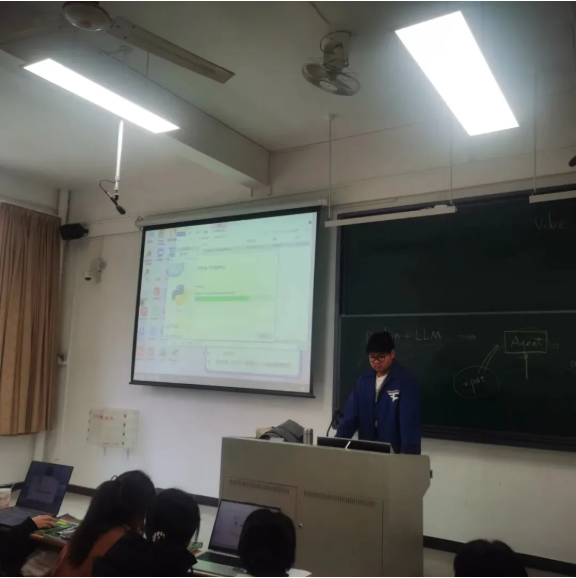
Three difficulties exist in learning College English, that is, undue feedback, insufficient pertinence, and lack of developing digital literacy. Given the traditional teaching approach cannot meet such requirements, Li Zhi from GCUT’s School of Foreign Languages created a “Learning Assistant based on Python and Large Language Model” drawing on technologies such as “easy-to-learn version of Python and API of Large Language Model”, which allow students to enjoy following services through establishing a Python environment, and design and execution of code structure:
Problem-solving approaches to English cloze tests: AI will analyze the logic of contexts automatically to compare the meanings and collocations of choices, and then generate detailed analysis of “correct answer, key clues, and analysis of common mistakes”, so as to achieve “solving problems with logic”.
A “private teacher” for English writing: it includes grammar check, suggestions on structure, and polishing of words and sentences. AI will generate layered feedback reports that can modified and improved for times.
Tailor-made learning plans: when inputting one’s English level, learning goals, and spare time, AI will automatically generate daily tasks, recommendations of learning resources, and related approaches and suggestions.
The course adopts a three-step approach featuring “demonstration - practice - reflection”, which first comes to independent thinking, then to AI analysis, and finally to comparison and reflection. It is user-friendly to students who have no programming foundations, which can improve students’ linguistic competence while enlightening their computational thinking.
Case 2
Database Concepts and Applications taught by Lu Hongju: AI has become a partner of learning from “facilitation” to “integrating with courses”
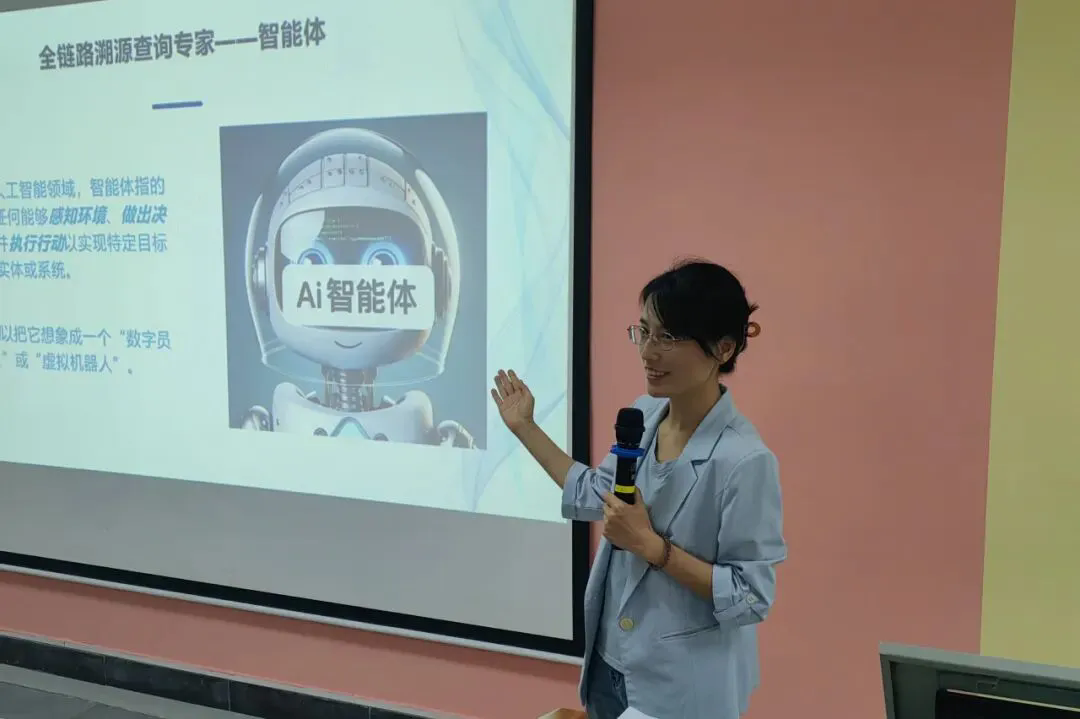
In traditional database courses, it is often the case that students just know about its principles instead of applications, nor to mention how to use it to solve actual data problems with AI. Lu Hongju established a new teaching model combined with AI featuring “dual integration and three-layered empowerment”, which makes AI a tool as well as a learning material.
The course adopts a three-stage strategy of “no integration - little integration - deep integration”:
Stage 1: restricting the utilization of AI to solidify foundations
Stage 2: guiding students to accomplish actual tasks with common large model
Stage 3: encouraging students to build AI agent for more explorations
From “imitation”, to “accomplishment”, and finally to “creation”, students can meet their learning requirements from these three dimensions based on various difficulties. Meanwhile, the course integrates the building and application of AI agent concerning homework, design, and practice, whose final exam concentrates on checking the core principles, thus forming a complementary evaluation system featuring “ empowered by AI and solidifying foundations”.
Case 3
Foundation of Intelligent Machinery and Robot taught by Zheng Yuanqiu: it makes deep learning no more “out of reach” from “abstract black box” to “direct visualization”
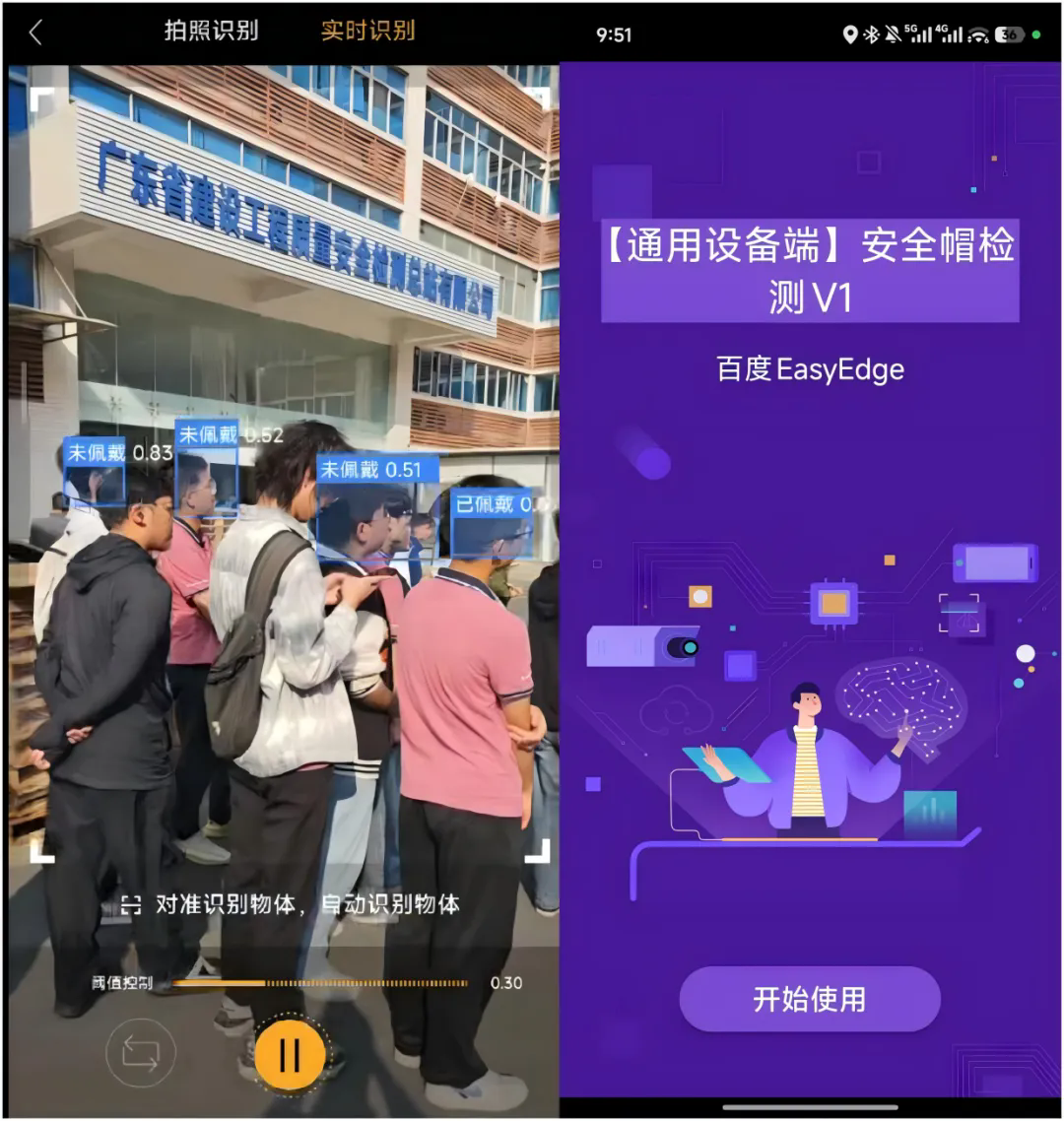
Abstract concepts such as overfitting and Loss daunted lowerclassman. Zheng Yuanqiu independently developed a virtual teaching application that invokes DeepSeek large model to generate virtual industrial data immediately, ensuring abstract concepts “visible”.
Students can observe real-time dynamic curves including Loss and Accuracy on the visualized interface to better understand the basic logic of “data - model - training”. Subsequently, the real-world project of “intelligent identification of safety helmet worn by architecture workers” was carried out dependent on EasyDL platform of Baidu Cloud, which requires students to label over 2,000 photos in groups, finishing the whole process from training to arrangement. Accuracy of some groups reached 99.2%.
From understanding curves to developing a product, it allows students to experience how AI engineers work.
Case 4
Principles of Architectural Designs taught by Liu Jiaqiong: from “watching architecture” to “creating architecture”, designs make them exit beyond time
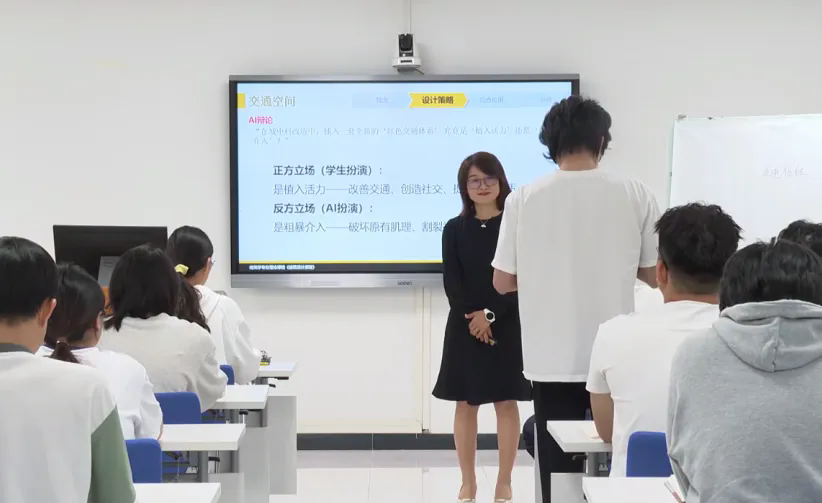
With “virtuality twists with reality·going through times” as the core principle, Liu Jiaqiong made a deep integration between AI technologies and architectural education. She created an “AI agent centering around principles of architectural designs” based on ChatGLM5, and achieve 24-hour personalized Q&A services as well as recommendation of resources on Xuexitong (an educational app).
It is worthy mentioning that she turned actual local cases such as that carried out in Sanhua Village, Luochang Village and Langtou Village into four-layered teaching scenarios including “actual courses - practice in villages - virtual models - feedback on courses”. Taking advantage of AI tools such as Metaso AI Bookshelf, AIRI lab, Dreamina AI, and Doubao AI, students can achieve previewing and practicing with guidance through “coordination between human and machine”.
Consequently, students gain better understanding in learning from “watching architectures” to “feeling, thinking, and creating architectures”.
Case 5
Electrical Parts of Power Plants taught by Ke Nan: from dealing with parameters to solve difficulties, making homework a “project delivery”
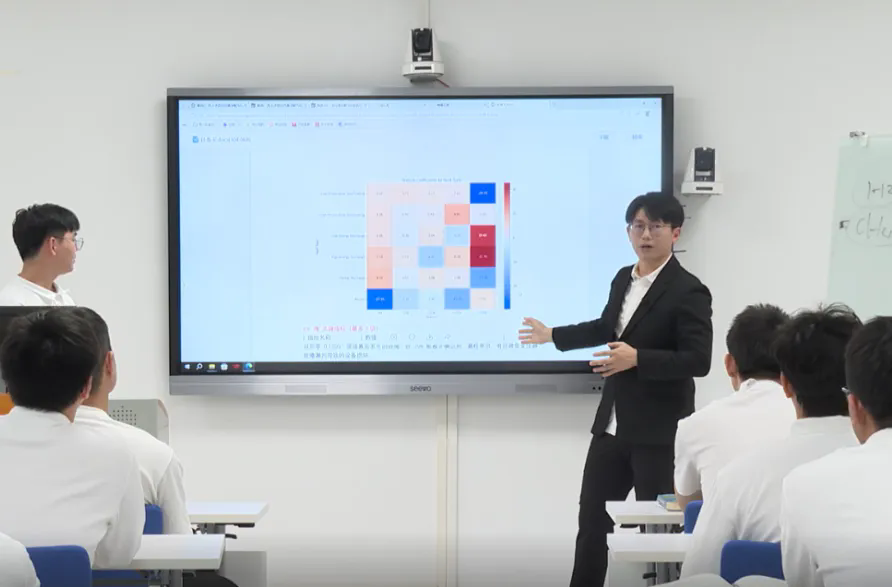
In traditional courses, students can master related parameters and principles while they don’t know how to use them in actual projects. Ke Nan summarized a PACE teaching method (including introducing with problems, agreed standards, solving construction problems, and reflection and assessment) that turns every course into a complete engineering practice.
Three micro-units that focus on practical training are inserted into the course, such as transformer fault diagnosis, regional load forecasting, and motor bearing fault diagnosis. Students can solve actual power-related problems with machine learning, regression and modeling, and feature extraction, thus accomplishing preprocessing data and validating models. Finally, they can deliver “operative codes, supported evidence and reproducible conclusions”.
Moreover, each micro-unit consists of three levels: first handling basic processes, then understanding models and improving parameters, and finally used them in new scenarios to form engineering advice.
Case 6
Digital marketing taught by Li Jiawen: making course a “real business market” from “learning marketing” to “being a part of marketing”
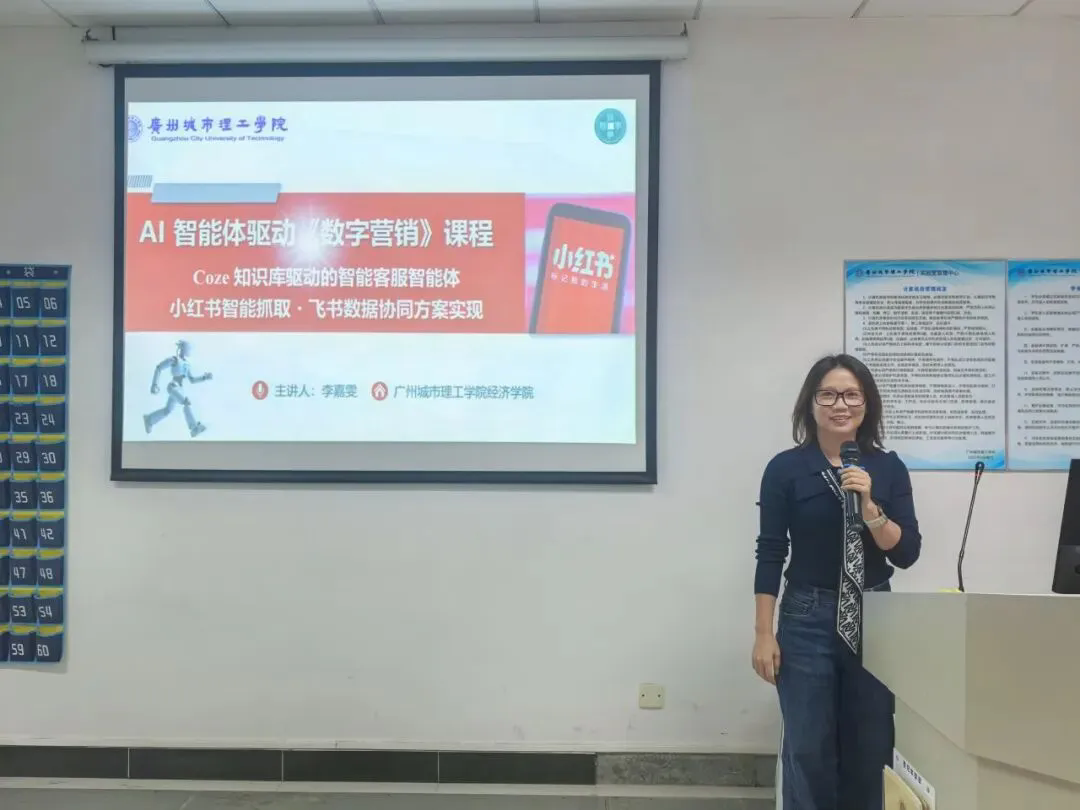
Faced with the trend of digital transformation, Li Jiawen built a technological system featuring “AI agent, knowledge base, data automation, and cross-platform coordination” with Coze (an AI application and chatbot development platform) as its core.
She made a deep integration between key knowledge (such as the Marketing Theory of 4Ps, customer journey, and AARRR model) and real marketing business (including establishing intelligent customer service, acquisition of marketing data, analysis of data cleansing, and automatic choreography of processes). Concentrating on “intelligent customer service” and “data-driven marketing”, students carried out real cases through data acquisition on Rednote and coordinated analysis of Feishu (an AI platform) to finish tasks from dividing requirements to building agents, and to cleansing data and output, through which they took part in the whole process of “business issues - technological dividing - solutions provided”.
Case 7
Econometrics taught by Liang Shan: boosting basic course from “traditional teaching” to “AI integration”
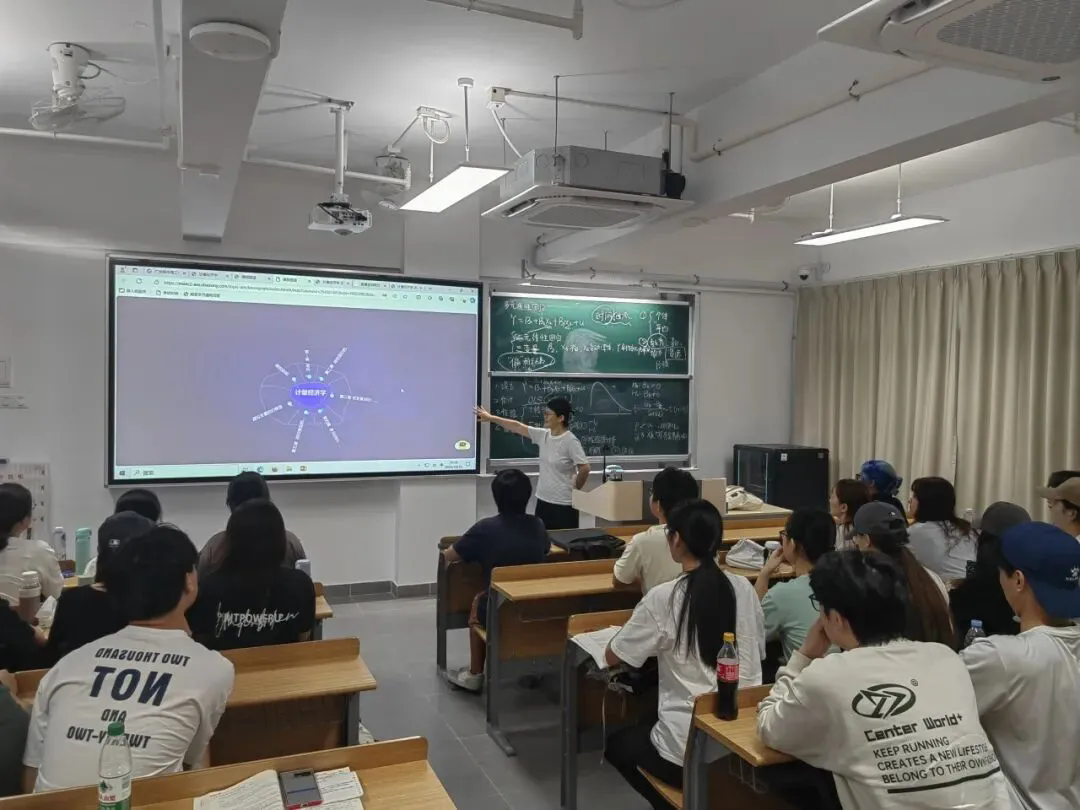
Liang Shan made a combination between traditional econometrics and advanced AI technologies.
When teaching “dummy variables”, she furthered the solutions to solving AI-related classification problems; she introduced the application logic of dimension reduction techniques when it comes to multicollinearity. Therefore, traditional teaching contents and new technologies support each other, building a practical and advanced knowledge-based system.
Moreover, an AI-integrated whole process teaching scenarios dependent on Xuexitong Platform has been established, which generate exclusive knowledge graph to provide a clear learning framework for students. Meanwhile, instant and personalized Q&A services will also be provided drawing on the function of AI-powered teaching assistant tool.
These changes may not be tremendous events, but they indeed take place in GCUTers’ daily study, which appear in faculties’ course outlines and students’ usage. They bring surprises to students that “AI could boost learning in such way”. GCUT’s faculties adopt AI as a new approach to education that is in line with the times.
Furthermore, such changes are not coincidence, which develop on the background of GCUT’s building a comprehensive ecology of AI talent cultivation. In the first semester of academic year 2025-2026, GCUT accelerated its construction of AI courses that 12 of its schools applied to offer 126 “AI+” courses. At the same time, training for faculty also keeps up with the trend, which covers over 2,000 attendances, thus primarily building the training system of “online self-learning, offline study and training, and tailor-made workshop”. Six online AI-related courses from 3 modules (Python programming, machine learning, and deep learning) on the platforms including MOOC of China’s universities and Chaoxing Erya have been divided into 2 training sessions with 1,328 attendances, 344 among whom passed the evaluation and certification of three courses. GCUT’s Center for Faculty Development has organized 3 offline thematic training with 220 attendances. Tailor-made workshops on artificial intelligence accumulated to be held 9 times with 475 attendances.
In this way, GCUT simultaneously promotes the development of professional clusters and industrial colleges, of which develop trials of 5 colleges and 6 majors. A provincial modern industrial college of artificial intelligence is also steadily advanced by three of GCUT’s schools, devoting to matching the requirements between professional and industrial clusters.